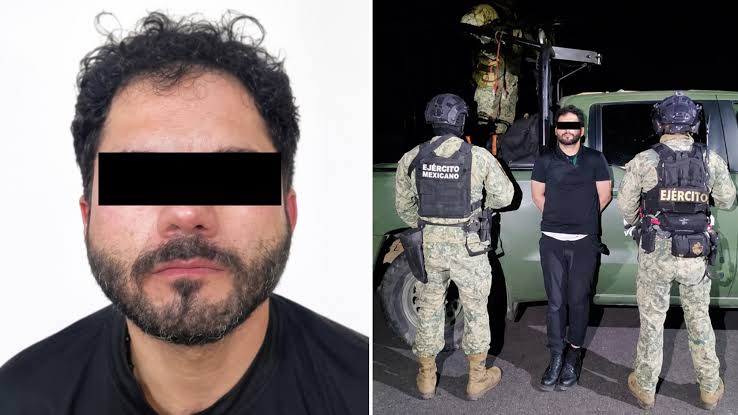
Mexican special forces have captured Fausto Isidro Meza Flores, the alleged cartel boss known as "Chapo Isidro" and a member of the FBI's Ten Most Wanted Fugitives list, in a Friday-night raid in Guasave, Sinaloa. The operation set off gun battles that killed 11 people, and U.S. prosecutors want him to face narcoterrorism and drug charges in federal court.
Mexico's military announced the arrest Saturday after flying Meza Flores, 44, and two alleged associates to Mexico City. One is Germán Rolando Gálvez Meza, known as "El Serafín," whom Mexican officials describe as the group's number two. The third man is identified as a financial operator. The Justice Department confirmed the capture the same day and credited a Homeland Security Task Force investigation.
Meza Flores has not been convicted in either country and is presumed innocent. Mexico says it holds an arrest warrant for him on organized-crime and drug offenses, along with a U.S. extradition order. He was held Saturday at the federal organized-crime prosecutor's office in Mexico City, and the reports reviewed show no public timetable for a handover.
A Raid That Was Not Finished Until 4 a.m.
Mexico's Defense Ministry says troops used "stealth and surprise" to seal off a house in Guasave, then came under fire from guns and explosives before moving in. Residents say the shooting erupted around 7 p.m. Friday, with helicopters and drones firing on locations across a city of roughly 290,000 people. Video showed spectators fleeing a baseball game while vehicles and convenience stores burned.
A federal official told the Associated Press that gunmen kept at least 10 roadblocks of burning vehicles in place, delaying Meza Flores's extraction until about 4 a.m. Saturday. Mexico's Defense Cabinet put the death toll at four soldiers and seven suspected cartel gunmen, and eight people were detained in all. Mexican officials said U.S. intelligence helped locate him.
Six Counts, One Docket and a Possible Death Sentence
The American case sits in federal court in Washington, D.C., under No. 12-cr-116 (BAH). Prosecutors first charged Meza Flores there in 2012 and widened the case in 2019. A grand jury returned a six-count second superseding indictment on Sept. 25, accusing him of leading a continuing criminal enterprise and conspiring to make and distribute cocaine, methamphetamine, heroin, marijuana and fentanyl for import into the United States. It also charges international money laundering conspiracy, conspiracy to support a terrorist organization, narcoterrorism and firearms offenses involving a machine gun and a destructive device.
Prosecutors allege he commanded armed men who controlled territory around Guasave, Los Mochis and Sinaloa's remote mountains, and that his organization killed rivals and kidnapped and tortured police officers. Those claims are unproven. If convicted, he faces the death penalty or mandatory life in prison. The U.S. Attorney's Office in San Diego and the Justice Department's Money Laundering, Narcotics and Forfeiture Section are prosecuting.
One Nickname, Several Cartel Labels
Despite the shared nickname, Meza Flores is not related to jailed Sinaloa Cartel founder Joaquín "El Chapo" Guzmán. The Justice Department calls him a senior Sinaloa Cartel leader, and notes that the State Department designated that cartel a foreign terrorist organization on Feb. 20, 2025. Mexican officials and the AP paint a more tangled picture: he rose through the Beltrán Leyva organization, later ran his own group, and is an ally of Los Mayos, a Sinaloa faction fighting a rival for control of the state. The FBI put him on its Ten Most Wanted list in February 2025, with a reward of up to $5 million.
The Kingpin Playbook and Its Aftershocks
U.S. and Mexican officials hailed the arrest. FBI Director Kash Patel said it was the 11th Ten Most Wanted fugitive captured under the current administration, and Mexico's security secretary, Omar García Harfuch, called it a step toward pacifying Sinaloa, where troops will stay deployed. On Saturday evening the State Department urged Americans in the region to be alert for possible violence.
Security analyst David Saucedo cautioned that the so-called kingpin strategy removes leaders but leaves networks of gunmen, dealers, businesses and political connections intact, which often sparks succession fights. The arrest also lands as President Donald Trump presses Mexico to confront the cartels.
Sources
- U.S. Department of Justice: Office of Public Affairs release, November 21, 2026justice.gov(opens in a new tab)
- U.S. Attorney's Office, Southern District of California: release and case numberjustice.gov(opens in a new tab)
- FBI: Ten Most Wanted Fugitives profilefbi.gov(opens in a new tab)
- Associated Press via PBS News: raid, casualties and analyst commentpbs.org(opens in a new tab)
- Al Jazeera: background, warrants and extradition orderaljazeera.com(opens in a new tab)
- CNN: State Department alert and Mexican security officials' accountcnn.com(opens in a new tab)
- NPR: number detained and transfer to Mexico Citynpr.org(opens in a new tab)