
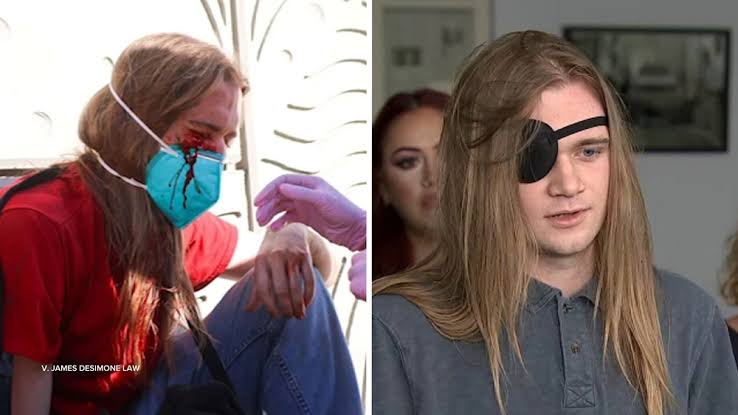
Tucker Collins, a 19-year-old University of Southern California student, sued the federal government on Nov. 23 over the loss of his right eye. He says a Department of Homeland Security officer fired a less-lethal projectile into his face on March 28 while he was photographing a protest outside the Metropolitan Detention Center in downtown Los Angeles. DHS had not commented on the suit as of Nov. 24, and none of the allegations has been tested in court.
The complaint, filed in Los Angeles federal court by attorney V. James DeSimone, names the United States and ten unidentified federal officers. It alleges violations of California’s Bane Civil Rights Act and, through the Federal Tort Claims Act, assault and battery, negligence and intentional infliction of emotional distress. His lawyers also frame the case around the Fourth and First Amendments, citing excessive force and the right to speak, assemble and record in public.
According to the filing, Collins was filming from 20 to 30 feet away from the fence, which he never approached, when officers on the other side began firing less-lethal rounds. He says he heard no dispersal order. DHS described a very different scene in March, calling the demonstration a riot, saying protesters threw rocks and cement blocks, and saying officers warned the crowd first.
"Simply recording what is happening in plain view should not cost anyone their sight.
— V. James DeSimone, attorney for Tucker Collins
The lawsuit says the round came from an FN-303 launcher, a weapon whose maker, according to the complaint, warns against aiming at the head or neck because of the risk of fatal injury. A video investigation by Mother Jones, cited in the filing, suggests the shot came from the detention center roof, about 125 feet from Collins.
Surgeons removed what remained of the eye. The complaint says Collins now has monocular vision, reduced peripheral vision and impaired depth perception, and that he will need prosthetic and eye care for life. His lawyers say everyday tasks, including driving, have become harder.
His attorney says the officer who fired has not been publicly identified and has not faced charges.
Why a $100 Million Tort Claim Came Before the Lawsuit
Suing the federal government over an employee’s conduct usually starts with an administrative claim. Collins’s lawyers say they presented a $100 million claim in April to DHS, Customs and Border Protection, Border Patrol and Immigration and Customs Enforcement. More than six months passed without a final answer, which cleared the way for a court filing.
The Federal Tort Claims Act is the main route for these cases because constitutional suits against individual federal officers have been sharply narrowed by the Supreme Court. Its law-enforcement proviso also keeps assault and battery claims alive when federal officers are involved, an exception that does not cover other federal workers.
Two Accounts of One Afternoon: Riot Response or Peaceful Documentation
The two sides disagree on nearly everything about the scene. DHS said in March that officers used the minimum force necessary and that the First Amendment protects peaceful assembly, not rioting. Collins’s complaint says no one near him was throwing anything and that he did not shout at officers or act in a threatening way.
Reports from the day also differ on warnings. KTLA described a dispersal order before tensions rose, while the lawsuit says Collins heard none. Video, the roof-position analysis and records showing who fired will likely drive the case, and the officer’s identity could stay a hurdle until discovery begins.
What the Complaint Asks the Court to Award
Collins is seeking:
✓ Compensation for medical costs, permanent disability and emotional distress
✓ Treble damages under California’s Bane Civil Rights Act
✓ Prejudgment interest, court costs and attorney fees
Federal law generally bars punitive damages and prejudgment interest against the United States in tort suits, so the government may challenge parts of that request.
A Wider Fight Over Force at Southern California Protests
Collins’s case arrives amid broader litigation over how federal agents police demonstrations in the region.
In L.A. Press Club v. Noem, a federal judge limited DHS force against journalists and protesters. On April 1, 2026, four days after Collins was hurt, the Ninth Circuit agreed the plaintiffs were likely to win First Amendment retaliation claims while calling the original order too broad. A 21-year-old protester has also said a federal projectile blinded him in one eye in Santa Ana in January.
I really want something to be done about this.— Tucker Collins, speaking to Scripps News
The next steps to watch are the government’s response to the complaint, any move to identify the officer and whether the court trims the damages sought. Until then, the account of what happened on March 28 remains a set of allegations that DHS has yet to answer.
Sources
- MyNewsLA: USC Freshman Blinded by DHS Projectile at Rally Sues Fedsmynewsla.com(opens in a new tab)
- Scripps News: College student sues federal government after losing eye during No Kings protestscrippsnews.com(opens in a new tab)
- Reason: USC Freshman Blinded in One Eye by DHS at ‘No Kings’ Rally Files Lawsuitreason.com(opens in a new tab)
- Davis Vanguard: USC Student Sues US Government After Federal Projectile Destroys Eyedavisvanguard.org(opens in a new tab)
- KESQ: USC freshman blinded by Homeland Security projectile at rally sues fedskesq.com(opens in a new tab)
- KTLA: 18-year-old loses eye after being shot during No Kings protest in downtown Los Angelesktla.com(opens in a new tab)
- Law360: 9th Circ. OKs Injunction On DHS Protest Conduct, With Limits (Los Angeles Press Club v. Noem, No. 25-5975)law360.com(opens in a new tab)
- Reporters Committee for Freedom of the Press: Los Angeles Press Club v. Noemrcfp.org(opens in a new tab)