
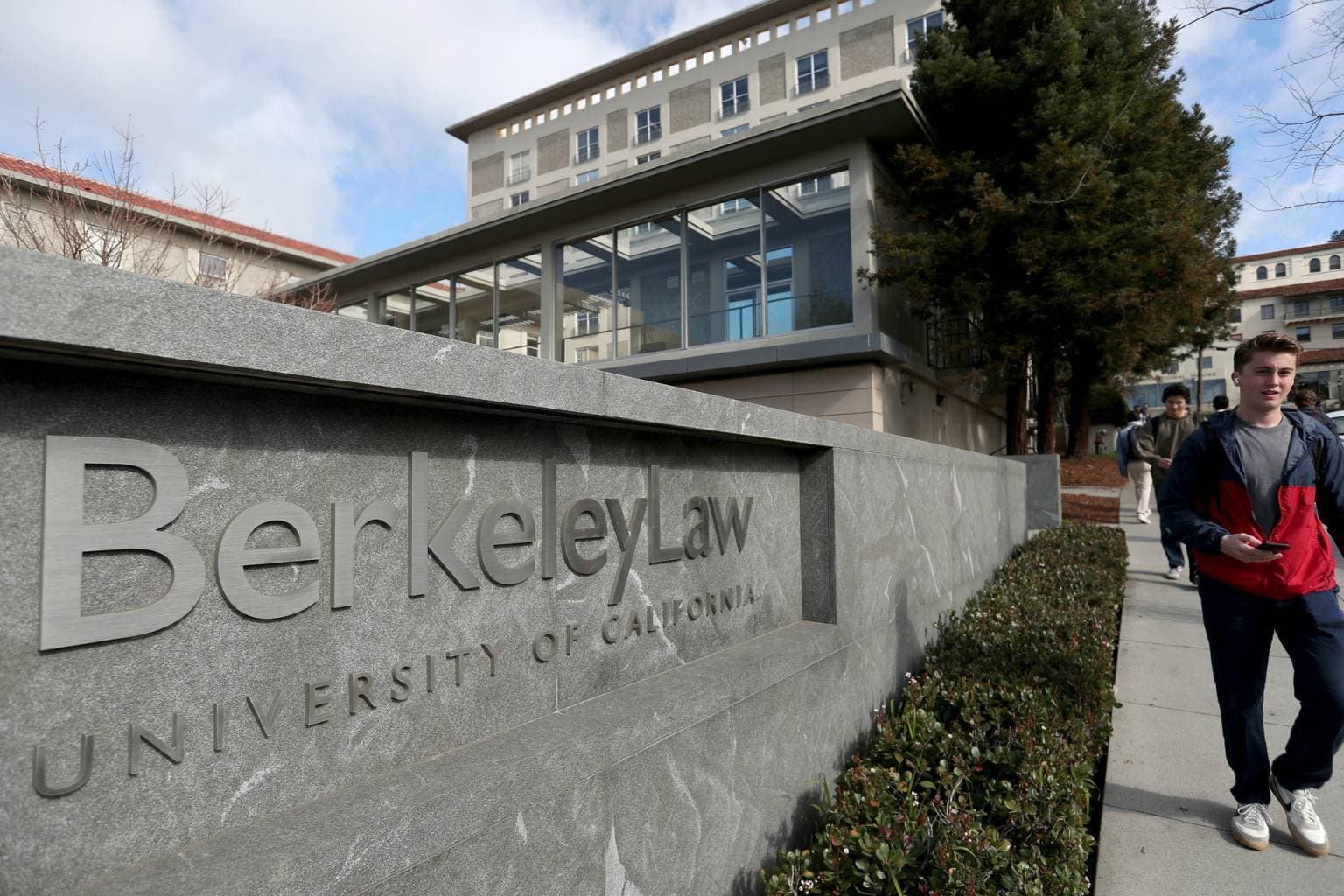
The U.S. Department of Justice says one of the nation's most competitive law schools broke federal civil rights law by weighing race in who it let in over two straight admissions cycles.
Federal investigators announced Wednesday that the University of California, Berkeley, School of Law discriminated against white and Asian applicants during its 2024 and 2025 admissions rounds, favoring Black candidates who, on average, posted notably lower standardized test scores. The findings, released jointly by the Justice Department's Civil Rights Division and the U.S. Department of Education, cap an 18-month compliance review that began less than two years after the Supreme Court banned race-conscious college admissions nationwide.
According to the government's analysis, Black applicants admitted to Berkeley Law in 2025 had nearly six times the odds of acceptance of white applicants with comparable academic records, and more than six times the odds the year before. Investigators also found that across both cycles combined, half of admitted Black students had LSAT scores below those of 95 percent of admitted white classmates, with more than a third scoring below 99 percent of them.
"Berkeley Law's efforts to get around the ruling show a complete disregard for the rule of law.
— Harmeet Dhillon, Assistant Attorney General, DOJ Civil Rights Division
The review began in March 2025, when the Justice Department opened a systemwide inquiry into University of California admissions under Title VI of the Civil Rights Act of 1964, the law barring race discrimination by recipients of federal funding. Investigators expanded the probe specifically to Berkeley Law a month later.
Much of the government's case rests on Berkeley Law's own application materials. Investigators say an admissions essay prompt built around 'diversity' functioned as an indirect way for applicants to disclose their race, while a separate section asked candidates to select a single racial or ethnic identity, describing it as a way to be grouped with classmates who shared that identity.
DOJ investigators also pointed to past public remarks by Berkeley Law Dean Erwin Chemerinsky, including a recorded comment describing what he called 'unstated affirmative action' in faculty hiring — language the department says shows awareness that the practice crossed legal lines.
By the Numbers
Federal investigators built their case largely on Berkeley Law's own applicant-level data from 2019 through 2025, focusing on the two admissions cycles that followed the Supreme Court's 2023 ruling in Students for Fair Admissions v. Harvard, which outlawed race-conscious college admissions.
The data shows a consistent LSAT gap between racial groups, with median scores for Black admits trailing those of white and Asian admits by roughly five to eight points depending on the year, according to the government's analysis. As of last fall, Berkeley Law enrolled 516 white, 293 Asian, 130 Hispanic and 51 Black students out of 1,128 total, according to school figures cited in the findings.
Berkeley Pushes Back
University leaders have firmly rejected the allegations. In a statement, the law school said its admissions process has complied with California's Proposition 209 — the 1996 ballot measure barring public institutions from weighing race — since it took effect, and that no applicant's race factors into admissions decisions.
Part of a Wider Federal Push
Berkeley Law is one of at least seven university professional schools where the administration has announced similar findings since launching a broader review of race-conscious admissions in January 2025.
✓ UCLA David Geffen School of Medicine
✓ Yale School of Medicine
✓ Duke University School of Law
✓ UC Davis and UC San Diego Schools of Medicine
An internal email cited in the findings shows Berkeley Law's dean of admissions acknowledged the risk of litigation over the school's approach but said the moment called for being clear about the institution's values.
What Happens Next
The Justice Department says it wants to negotiate a voluntary resolution agreement with Berkeley Law to bring its admissions practices into compliance with Title VI.
If the university does not reach an agreement, the department has signaled it is prepared to sue — a step that would move the dispute into federal court and could set precedent for how post-SFFA admissions practices are policed at other schools nationwide.
No student should be advantaged or disadvantaged because of the color of their skin.— Kimberly Richey, Assistant Secretary for Civil Rights, U.S. Department of Education
For now, Berkeley Law's admissions policies remain unchanged and no lawsuit has been filed. But the findings put California's flagship law school at the center of the administration's fastest-growing civil rights enforcement priority: rooting out race-conscious admissions in higher education nationwide.