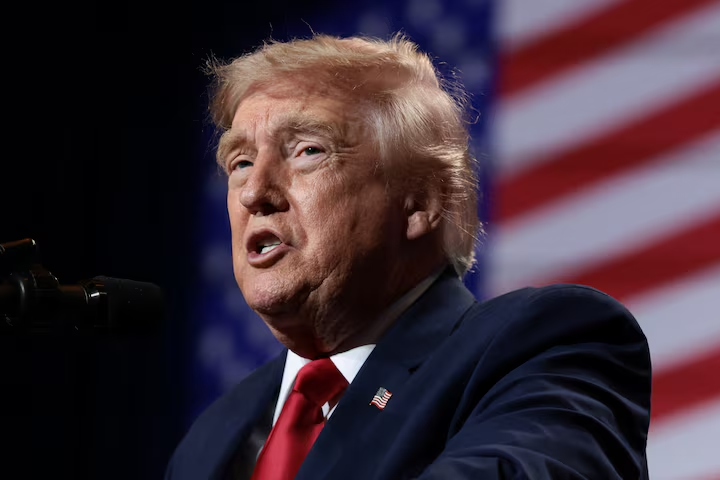


Trump is set to land in Manila on Tuesday to open a four-day Asia trip that ends with the first three-way meeting among the leaders of the United States, China and Russia. It comes days after Democrats won both chambers of Congress, leaving the president with deals to chase but limited leverage to close them.
Senior U.S. officials said Friday that Trump is expected to sign a trade deal with Thailand, meet Quad leaders and join a special U.S.-ASEAN session in Manila. In Shenzhen, he will hold a bilateral meeting and working lunch with Chinese President Xi Jinping on Thursday, then join a trilateral conversation with Russian President Vladimir Putin.
Officials called the three-way meeting an opening discussion on nuclear weapons and expect no concrete agreement. Iran is expected to come up, Ukraine is not, and no one-on-one session with Putin is planned. Trump and Xi plan to focus on implementing aspects of their existing trade agreement.
"There will be no substantive progress made between Trump and Xi.
— Greg Poling, geopolitical analyst, quoted by The Associated Press
Manila will be a short stop. Trump arrives Tuesday afternoon, after the main ASEAN meetings end, and joins the Quad session and a special summit with ASEAN leaders. Philippine officials say his state visit with President Ferdinand Marcos Jr. includes a Wednesday luncheon at the presidential palace.
The Quad meeting is the first gathering of its leaders since Trump returned to office, with Australia, India and Japan expected to attend. Nearly 20,000 police officers have been deployed around Manila, where an anti-Trump march is expected.
Not every item will land. U.S. and Philippine officials say the proposed Pax Silica agreement, a U.S.-led effort on chips, AI and critical minerals, will not be signed during the summit. Manila hopes to finalize it by year-end.
What Is on the Table With Xi in Shenzhen?
The U.S.-China trade truce is the practical focus. It was extended to early next year, and former State Department official Kurt Tong expects another extension beyond its Jan. 10 expiration. Trump and Xi are also due to meet again at the G20 in Miami in December.
Taiwan is the harder file. Beijing wants Trump to hold back a $14 billion arms package, which he has called a negotiating chip. Democrats are urging him to complete the sale, and Council on Foreign Relations analyst Joshua Kurlantzick says congressional staffers see enough support to push it through over a veto.
Nvidia Scandal and Pax Silica Complicate the Agenda
Nvidia has become an unwelcome subplot. Jensen Huang resigned as chief executive last week after admitting an affair with an alleged Chinese government agent, which Beijing denies. Officials say Trump will not raise it with Xi, and House Speaker Mike Johnson says Congress is building consensus for tighter limits on Chinese access to advanced chips.
That matters for Pax Silica. Kurlantzick argues Washington faces an uphill sell in a region where cheaper Chinese AI models are gaining customers and five Southeast Asian countries have joined a China-led AI cooperation body. Any trade frameworks with Vietnam and Thailand, he adds, may amount to little more than outlines.
What to Know Right Now
Officials are lowering expectations, and analysts say both capitals want to keep trade tensions contained.
✓ Tuesday: Quad meeting, U.S.-ASEAN session and expected Thailand trade deal in Manila
✓ Wednesday: Marcos state visit, then on to Shenzhen
✓ Thursday: Trump-Xi talks, then the Trump-Xi-Putin trilateral
✓ Not expected: a Pax Silica signing or a concrete nuclear arms deal
Elon Musk will join parts of the China leg but not official talks.
Midterm Defeat Follows Trump Across the Pacific
Democrats take control of the House and Senate in January, and Kurlantzick says dealing with Xi and Putin is unpopular among Democrats and many Republicans. Beijing also knows Trump's term ends in two years and a successor could take a harder line.
Kurlantzick writes that Marcos, long the region's most pro-U.S. leader, has grown frustrated with what Manila has received and has begun tilting toward Beijing, even as China presses Philippine vessels in the South China Sea.
They both have quite a lot to lose.— Chim Lee, senior China analyst, Economist Intelligence Unit, quoted by Reuters
Watch for the Thailand signing, any Taiwan arms signal from Shenzhen and whether the trilateral produces more than a statement on nuclear risks.
Sources
- ABC News: Trump to meet with Putin and Xi in China next week, US officials sayabcnews.com(opens in a new tab)
- AP via ABC News: Southeast Asian leaders open annual summit with major conflicts topping the agendaabcnews.com(opens in a new tab)
- Reuters via Yahoo News: Spy scandal and midterm defeat heat up Trump's Asia visityahoo.com(opens in a new tab)
- Associated Press: Trump is taking Elon Musk on his Asia trip, but plans to avoid talking about Nvidia scandalapnews.com(opens in a new tab)
- Associated Press via WRAL: Trump's Asia reset: Deals in Manila and Shenzhen, then a rare nuclear summit with Xi and Putinwral.com(opens in a new tab)
- Foreign Policy: Lame-Duck Trump Heads to Asiaforeignpolicy.com(opens in a new tab)
- Philstar: No Pax Silica announcement during ASEAN, US envoy saysphilstar.com(opens in a new tab)
- Philstar: Philippines, US may sign Pax Silica AI hub framework within 2026philstar.com(opens in a new tab)
- Khaleej Times: Trade war in focus at ASEAN summit ahead of Trump arrivalkhaleejtimes.com(opens in a new tab)
- Council on Foreign Relations: Trump's Asia visit analysis by Joshua Kurlantzickcfr.org(opens in a new tab)