
The Federal Communications Commission is set to vote Thursday on rules that would, for the first time, let state and local prisons and jails apply to jam the signals of contraband cell phones. The order would allow the technology but not require it, and any facility that wants to use it would need FCC approval and have to prove its system does not leak beyond the areas it is meant to cover.
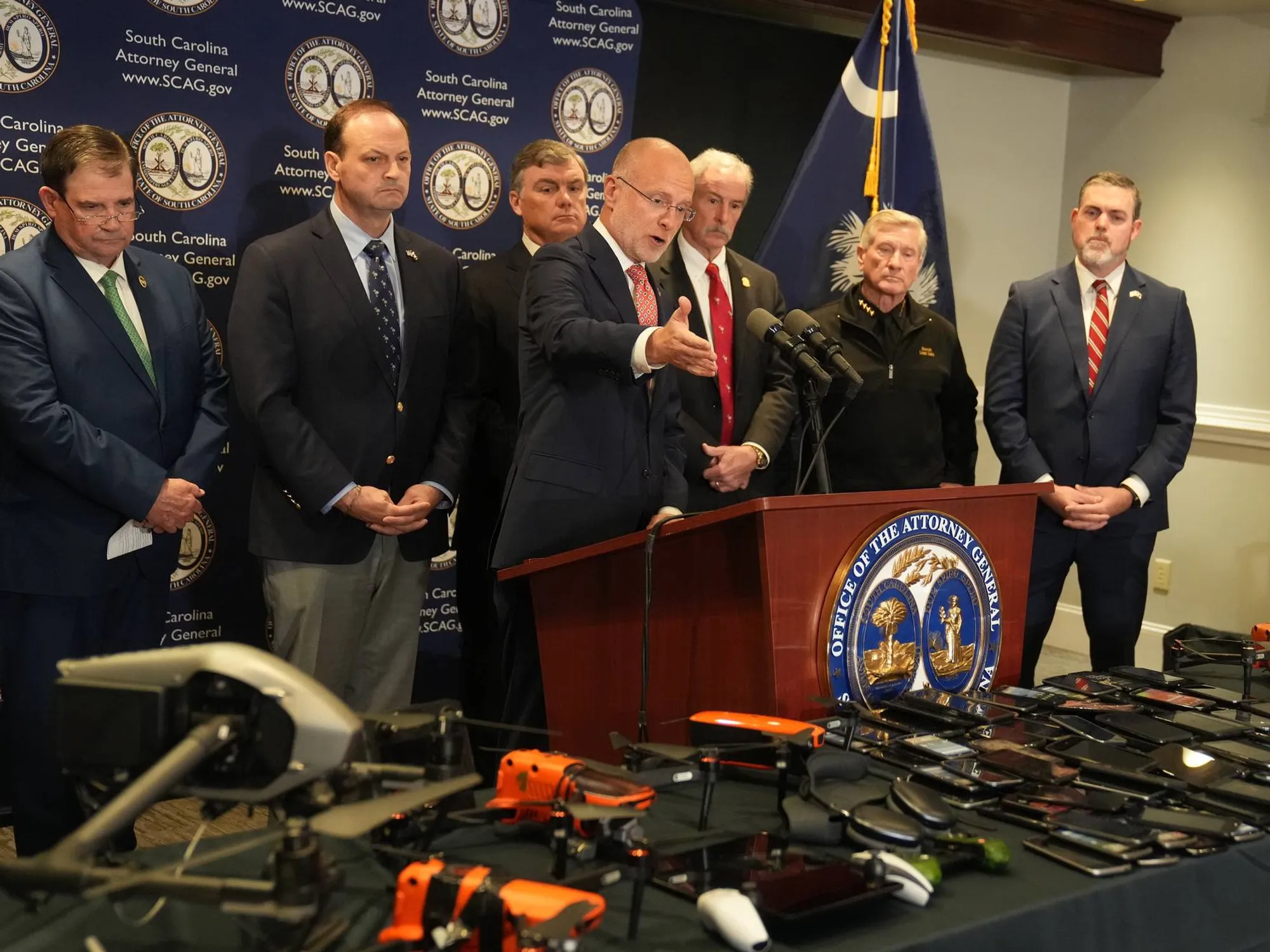
FCC Chairman Brendan Carr said Wednesday in Columbia, South Carolina, that he is confident the commission has the votes. Standing with Attorney General Alan Wilson, Corrections Director Joel Anderson and other state officials in front of seized phones and smuggling drones, he said about 25,000 contraband phones are pulled from state and local prisons each year and that roughly 500,000 inmates have had access to one. Authorities call the devices the top security threat in correctional facilities. The item, titled Combatting Contraband Wireless Device Use in Correctional Facilities, is on the commission’s November open meeting agenda.
Supporters say inmates use the phones to order hits, run drug operations and carry out scams from behind bars. Federal prisons are already allowed to jam signals, but state and local facilities have been shut out by federal limits on interfering with licensed wireless service. The FCC’s plan rests on declaring that service to smuggled phones inside a prison is not authorized under Section 333 of the Communications Act. The commission’s three members advanced that idea unanimously in September 2025.
"This isn’t going to be a silver bullet at the end of the day.
— FCC Chairman Brendan Carr, as reported by WACH
Under the draft order, a prison or jail would apply for authorization and could aim jamming at specific areas inside a facility rather than covering a whole neighborhood. Before going live, operators would test under an experimental license to show the system causes no harmful interference outside the designated zone, and the FCC would require more testing after a license is granted.
Nothing in the order forces a state to adopt jamming. Facilities that prefer other tools, such as managed access systems that identify and shut off unauthorized phones, can keep using them.
Arkansas Sen. Tom Cotton, who joined Carr at an Oct. 28 announcement in Little Rock, says he will keep pushing his Cellphone Jamming Reform Act to write the change into federal law.
Wireless Carriers Warn About 911 and Interference
The wireless industry has fought the idea for months. In a Nov. 12 filing, the trade group CTIA asked the FCC to tighten safeguards in the draft, warning that jamming could disrupt 911 calls and emergency alerts. It pointed to a recent test at a South Carolina prison that it says showed interference both inside and outside the facility.
AT&T, Verizon and other industry groups argued earlier that blocking signals could hit lawful devices in and around a prison, and CTIA and others point to managed access systems as the better fix. Commissioner Anna Gomez voted for the 2025 proposal but cautioned about unintended consequences of letting non-federal operators jam signals.
South Carolina Pushed for Years to Jam Phones
South Carolina has served as the testing ground. The FCC allowed a one-time jamming demonstration at a maximum-security prison in 2008, and Corrections Director Joel Anderson says the state’s testing at Broad River Correctional in Columbia showed the systems work.
State leaders also cite violence tied to smuggled phones. Capt. Robert Johnson, a former South Carolina anti-contraband officer, was shot multiple times at an inmate’s direction, and Carr has pointed to his case in backing the plan. Lawmakers there have spent $18.5 million over two years on technology that tracks cell signals inside prisons.
What Comes Next After the Vote
If the commission adopts the order, state corrections departments can begin applying for licenses. South Carolina’s prison agency says it is ready to act as soon as permission arrives.
Arkansas Attorney General Tim Griffin argues that authorizing jamming could draw private investment and push prices down as more vendors compete. Anderson welcomed the FCC’s first step in 2025.
Inmates with illegal cellphones commit serious crimes.— Joel Anderson, South Carolina Department of Corrections director, in a 2025 statement
Watch for the commissioners’ vote count, the order’s publication in the Federal Register, the first state applications and any challenge from wireless carriers.
Sources
- The Associated Press via WTOP: FCC expected to allow state prisons to jam contraband cellphone signals with Thursday votewtop.com(opens in a new tab)
- Benton Institute (FCC release): FCC Announces Tentative Agenda for November 2026 Open Meetingbenton.org(opens in a new tab)
- Benton Institute (FCC release): Chairman Carr Announces Vote to Permit Prisons to Jam Contraband Cellphonesbenton.org(opens in a new tab)
- Federal Communications Commission: Promoting Technological Solutions to Combat Contraband Wireless Device Use in Correctional Facilities (FCC 25-65)docs.fcc.gov(opens in a new tab)
- Federal Register: Third Further Notice of Proposed Rulemaking summary (GN Docket No. 13-111)federalregister.gov(opens in a new tab)
- Broadband Breakfast: FCC to Vote on Prison Cellphone Jamming Rules in Novemberbroadbandbreakfast.com(opens in a new tab)
- Broadband Breakfast: Wireless Industry Seeks Changes to FCC’s Proposed Prison Phone Jamming Rulesbroadbandbreakfast.com(opens in a new tab)
- Broadband Breakfast: Industries Opposed to FCC Prison Jamming Proposalbroadbandbreakfast.com(opens in a new tab)
- WACH Fox 21 (ABC News 4): Contraband cellphones, FCC announces vote to authorize prisons to jam cellphonesabcnews4.com(opens in a new tab)
- WRDW: FCC to vote on prison cellphone jamming that S.C. leaders have soughtwrdw.com(opens in a new tab)
- South Carolina Daily Gazette: FCC set to vote on cellphone jamming in prisons after yearslong push from SCscdailygazette.com(opens in a new tab)
- South Carolina Daily Gazette: FCC votes to move forward with cellphone jamming (Sept. 30, 2025)scdailygazette.com(opens in a new tab)
- Route Fifty: Feds vote to move forward with cellphone jamming, a longtime priority for South Carolina prisonsroute-fifty.com(opens in a new tab)