Montauk Mary: How Six Cold Case Victims Got Their Names
Follow how DNA named Montauk Mary and five other Suffolk County cold case victims, from a 1976 Deer Park find to a possible Biegenwald link still unproven.

·10 min read
For almost fifty years, six people sat in Suffolk County's files without names. One was a burned man found by rabbit hunters in Deer Park. One was a woman buried in beach sand at Heckscher State Park. One was an elderly woman shot dead beside a Montauk overlook. The other three were found in a wooded lot, in the Atlantic and along a rocky shoreline. On November 12, 2026, District Attorney Raymond A. Tierney and the Suffolk County Police Department announced that all six now have names. [1][3]
Three of the six are homicide victims. The best known is the woman called Montauk Mary, now identified as Sofia Margherita Marrone, a 73-year-old from Pleasantville, New Jersey. Her case has drawn the most attention because investigators are looking at a possible connection to the late New Jersey serial killer Richard Biegenwald. That connection has not been proven with forensic evidence, and this article keeps the confirmed facts and the open theories apart. [1][3][7]
The account below draws on the District Attorney's announcement, the office's case pages and published reporting through November 17, 2026. It does not claim new interviews or records that have not been made public.
Six names and three homicides
The announcement came at a press conference at the Suffolk County Police Academy in Brentwood. Tierney said the six names were being made public for the first time, in cases that reach back to 1976. The work was done by the Cold Case Task Force, a partnership between the District Attorney's Cold Case Unit and county police detectives that Tierney created in April 2024. [1][3][10]
Three of the people are treated as homicide victims: Ramon Perez y Rivera, Sofia Margherita Marrone and Antoinette Rugg. Omelios Steward is believed to have drowned. The causes of death for Kyong-Ok Kim and Andreas Kupke are still unresolved. Tierney made a point of saying that not all six are believed to have been murdered. [1][3]
"Every person deserves to be known by their name," Tierney said in the office's statement. He described the identifications as a first step toward learning what happened to each person and giving families answers. [1]
A woman in a tweed coat at the Montauk overlook
Around 12:30 p.m. on March 22, 1978, a man on his lunch break at East Overlook Park, off Montauk Highway, saw a body lying face up about 15 feet from the parking area. The District Attorney's statement calls him an airman. East Hampton Press later identified him as Edward Kenney of Amagansett, a civilian employee at the Camp Hero Air Force base. Kenney, now 96, has said he ate lunch looking out at the water and, as he headed back to his car, noticed something pink on the ground. It turned out to be her slippers. [1][4]
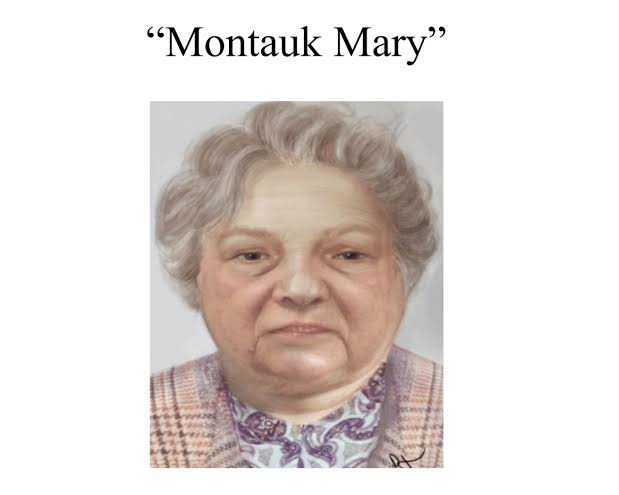
She was about five feet tall, with short gray hair and hazel eyes, and she wore a tweed coat, a dress and slippers. None of her clothing carried a label. The medical examiner found four gunshot wounds, one in the chest and three in the legs, and concluded she had died only hours before she was found. [2][3]
Detectives could not work out who she was, and the case settled into local memory under the name Montauk Mary. Kenney recalls being questioned over and over, and says police stopped traffic on the road for days to ask passersby what they had seen. East Hampton Press describes it as the most enduring unsolved crime in the town's history. [4]
The retired officers who kept the case alive
Local police never fully let go. Tom Grenci, a retired East Hampton Town police lieutenant, says the case has been on his mind since he was a teenager. After the arrest of Rex Heuermann in the Gilgo Beach murders, Grenci and two other former officers, Edward Ecker and Charles Morici, pushed the case back into view in the hope that modern DNA work could finally give her a name. Morici died last spring. [3][5]
Grenci raised the case with Suffolk Police Commissioner Kevin Catalina in the summer of 2025, and a few months later the District Attorney's unit took it on. In September 2025, during National Cold Case Month, the Task Force put Montauk Mary back in the public eye with new details and an updated sketch made with a county police forensic artist. [2][3][9]
Grenci attended the announcement and said the call that reached him a few weeks earlier left him floored. He told CBS New York that she had been "Montauk Mary my whole life," and that now she had a name. [3][5]
Sofia Margherita Marrone
The woman in the tweed coat was Sofia Margherita Marrone of Pleasantville, New Jersey, born January 18, 1905. Investigators say she was last seen on March 16, 1978, as she left Shore Memorial Hospital in Somers Point, New Jersey. Six days later she was found in Montauk. She was 73. [1]
Her great-grandnephew was at the press conference. He declined to speak to reporters, but Grenci says he thanked the people involved. Kenney, the man who found her, said he was glad the case had been solved, and sad that most of the people who loved her had died without ever learning what happened. [3][4]
Why investigators are looking at Richard Biegenwald
Once Marrone was tied to the Jersey Shore area, Tierney said, the name Richard Biegenwald surfaced quickly. Biegenwald, known in the press as the Jersey Shore "Thrill Killer," has been linked to nine murders, Tierney said, and was convicted of six of them in New Jersey. He died in prison in 2008. [3][6]
Several details caught investigators' attention. Marrone was shot with .22-caliber short rounds, a rare kind of ammunition, and New Jersey police found the same kind when they arrested Biegenwald in 1983. Tierney said Biegenwald was known to pick up women who were walking in Jersey Shore towns, and Marrone had left a hospital just blocks from a bridge to the shore. A witness also told police in 1978 that he had seen a bearded man in a gold-colored car with New Jersey plates at the overlook that morning. That tip was not central to the original investigation. Biegenwald had a beard and owned a car that loosely matched. [3][6]
None of this amounts to proof. Tierney said investigators have not been able to tie Biegenwald to the killing through DNA or other forensic evidence, and that the investigation continues. Authorities have stopped short of calling the case solved. Police have also not publicly explained how Marrone ended up in Montauk, though they say Biegenwald had some past ties to Long Island. [3][4][6][7]
Because Biegenwald died in 2008, no trial can test the theory. Whatever investigators conclude will have to rest on the evidence they can still develop.
The two other homicide victims
The oldest case dates to November 27, 1976. At about 10:30 a.m., three people hunting rabbits in Deer Park found a man lying face up, his body severely burned. The investigation found he had been shot in the lower right abdomen, and that wound killed him. A tattoo reading "Raymond" on his left upper arm gave him the only name he had for almost fifty years: Raymond Doe. [1]
He was Ramon Perez y Rivera, born in October 1935 in Arecibo, Puerto Rico. The last official record of him alive is the 1950 U.S. Census, recorded on April 17 of that year, which listed him as "Raymond" and placed him in South Williamsburg, Brooklyn. He would have been about 41 when he died. [1]
Antoinette Rugg's case began on April 2, 1978, when a man walking his dog along the beach at Heckscher State Park noticed the dog scratching at loose sand. The sand had exposed what looked like the top of a human skull. Police uncovered skeletal remains with a belt pulled tightly around the neck, and the autopsy found she had been strangled. [1]
She was Antoinette Rugg of Lindenhurst, born August 2, 1951. She was 26 and had a 10-year-old son, who stood beside Tierney at the press conference. [1][3]
Three more names, three open questions
Kyong-Ok Kim was found on March 12, 1990, by a Riverhead Town employee driving a street sweeper near a wooded area off Osborne Avenue. At first he thought he was looking at a mannequin. According to the District Attorney, law enforcement had identified her earlier, but her name was never made public until now. [1]
Kim was born on November 30, 1957, in South Korea. Investigators say she married in 1978, moved to the United States, settled in Michigan and gave birth to a son that year. Around 1985 she became estranged from her family and moved to New York, where she worked for a time at a Manhattan grocery store and lived in Woodside, Queens. She was 32 when she died, and her cause of death remains under investigation. [1]
Omelios Steward, born June 23, 1962, was 28 when the U.S. Coast Guard found his body floating in the Atlantic about nine miles south of Fire Island on November 4, 1990. Investigators believe he drowned. Advances in fingerprint analysis restored his name after almost 36 years. [1]
Andreas Kupke was a 27-year-old German citizen, born September 23, 1972, who flew into Newark International Airport on November 24, 1999, for a visit scheduled to end on December 4. He never boarded the flight home, and his parents reported him missing in Germany. On Christmas Eve, a partially decomposed body was found at the high-tide line in a rocky cove east of Ditch Plains in Montauk. [1][3]
Theories at the time ran in several directions. One early idea was that the body had come from the wreckage of EgyptAir Flight 990, which crashed in the ocean south of Nantucket that October. No link was ever made, Tierney said. Todd Sarris, then an East Hampton Town police captain, recalls talk of a plane and of a ship. Naming Kupke took Suffolk investigators working with Interpol, the New Jersey State Police, East Hampton Town Police and German authorities. Nothing is publicly known about his movements after he landed at Newark, and his cause of death is still unknown. [1][3][4]
Kupke's parents learned what had happened to their son almost 27 years after he disappeared. Tierney said they were shocked and grateful that people an ocean away were still working on the case. [3][5]
How the identifications happened
For the three homicide victims, the key was Next Generation Sequencing, or NGS, paired with investigative genetic genealogy. In each case the Task Force first built a standard DNA profile from the remains and uploaded it to CODIS, the FBI-managed national database used to compare unidentified remains with missing persons and with relatives who have given reference samples. The names came through NGS and genealogy work. [1]
NGS can pull usable DNA from very old samples, including decades-old hair, and investigators then search databases for relatives. It is the same approach that helped identify victims in the Gilgo Beach serial killing case, where Heuermann ultimately pleaded guilty to killing eight women. [3][5]
The District Attorney's office thanked a long list of partners, among them Astrea Forensics, Bode Technology, the New York City Office of the Chief Medical Examiner and the FBI's Latent Print Unit. A federal grant program for missing and unidentified human remains helped pay for the work. [1]
The method is still being debated in Albany. In October, Tierney urged a state forensic panel to let New York's public laboratories use NGS, which is currently done only in private labs. Experts who testified said the technology needs safeguards because genetic data is so personal. Another hearing is expected in December. [1][8]
What remains unanswered
The identifications are a beginning. Without names, investigators had nowhere to start in the three homicides. With names, they can look at who these people were, who they knew and where they had been. Tierney said homicide investigations start with identity, and he asked anyone who knew the victims or has information about their lives or deaths to come forward. [3]
Many questions are still open. Investigators have not publicly named a suspect in the deaths of Ramon Perez y Rivera or Antoinette Rugg. Kyong-Ok Kim's cause of death is undetermined. No one has explained what happened to Andreas Kupke after he reached Newark. And the case against Biegenwald in Marrone's killing remains a theory. [1][3][6]
Anyone with information about any of the six can call Suffolk Crime Stoppers at 1-800-220-TIPS (8477); translation services are available. Tierney also said the public can help future cold cases by uploading their DNA to public genealogy databases and opting in to law enforcement searches. [1][5]
East Hampton Town police still have one open case involving an unidentified person, and Detective Sergeant Frank Sokolowski said the department hopes the same kind of coordinated work can eventually resolve it. For Kenney, who has wondered about the woman he found for 48 years, the news was welcome. "I was overjoyed when I heard they'd figured it out," he said. [3][4]
The evidence and what it established
| Evidence | Investigative significance |
|---|---|
| Next Generation Sequencing and genetic genealogy | Produced the names of Rivera, Marrone and Rugg from remains that had gone unidentified for decades. [1][5] |
| .22-caliber short rounds | Matched a rare ammunition type found when New Jersey police arrested Biegenwald in 1983. Investigators treat it as a point of interest, not proof. [3][6] |
| 1978 witness report | Described a bearded man in a gold-colored car with New Jersey plates at the overlook. It was not central to the original investigation and does not identify anyone by itself. [3] |
| Fingerprint analysis | Led to Omelios Steward's identification after almost 36 years. [1] |
| 1950 U.S. Census record | The last documented record of Ramon Perez y Rivera, listing him as Raymond in South Williamsburg, Brooklyn. [1] |
| International records and cooperation | Tied the Montauk remains to Andreas Kupke's 1999 arrival at Newark and his parents' missing-person report in Germany. [1][3] |
| Forensic link between Biegenwald and Marrone | Not established. Tierney said investigators have not tied him to the killing through DNA or other forensic evidence. [3][7] |
Editorial note: Historic Investigations is part of CourtNews Investigations. This article reports on cold case identifications announced on November 12, 2026, and reflects published information through November 17, 2026. No court has found anyone responsible for any of the three homicides. Richard Biegenwald is described only as a possible suspect in the Marrone case; the District Attorney's office says no forensic link has been established. The District Attorney's statement calls the man who found Marrone's body an airman, while East Hampton Press identifies him as Edward Kenney, a civilian employee at Camp Hero. Reports differ slightly on the years and number of killings tied to Biegenwald; this article uses the figures Tierney gave at the press conference. The causes of death for Kyong-Ok Kim and Andreas Kupke have not been determined. No dialogue or private thoughts have been invented.
Sources & records
10 sources- 1Suffolk County District Attorney's Office, official announcement (reproduced by LongIsland.com)November 12, 2026. Names, dates, discovery details, methods, partners and tip line for all six cases.longisland.com (opens in a new tab)
- 2Suffolk County District Attorney: Montauk Mary case pagePhysical description, clothing, wounds and the 2025 updated sketch.suffolkcountyda.org (opens in a new tab)
- 3East Hampton Press: Investigators Reveal ID of 'Montauk Mary' and Likely KillerPress conference details, Biegenwald evidence and limits, retired East Hampton officers, Kupke case background.27east.com (opens in a new tab)
- 4East Hampton Press: Nobody Wondered About 'Montauk Mary' Longer Than Ed KenneyNovember 17, 2026 follow-up with Edward Kenney, who found Marrone's body in 1978.27east.com (opens in a new tab)
- 5CBS New York: New DNA technology helps ID victims in multiple Long Island cold casesNovember 12, 2026. How NGS works, Grenci's reaction, families' response and the public DNA database appeal.cbsnews.com (opens in a new tab)
- 6Fox News: Cold case DNA unmasks 'Montauk Mary' as cops probe link to Jersey Shore 'Thrill Killer'November 13, 2026. Biegenwald ammunition and witness details; authorities stop short of calling the case solved.foxnews.com (opens in a new tab)
- 7Daily Voice: 'Montauk Mary' Identified Among Six Long Island Cold CasesTierney's statement that Biegenwald has not been forensically tied to the crime.dailyvoice.com (opens in a new tab)
- 8ABC7 New York: Gilgo Beach murders case highlights push for advanced DNA useOctober 2026 Albany hearing on NGS, private-lab use only, privacy safeguards and a December hearing.abc7ny.com (opens in a new tab)
- 9Suffolk County District Attorney: National Cold Case Month announcement (2025)September 15, 2025 release spotlighting Montauk Mary and two other unsolved cases.suffolkcountyda.org (opens in a new tab)
- 10Suffolk County District Attorney: Cold Case Task Force backgroundCreation of the Cold Case Task Force in April 2024.suffolkcountyda.org (opens in a new tab)
Investigation news Author
Michael Grant is an investigative journalist focusing on corruption, government accountability, corporate misconduct, and data-driven reporting.