Afederal appeals court in New York handed Donald Trump another legal defeat on April 29, 2026, refusing to convene a full panel of judges to reconsider the $83.3 million defamation judgment that magazine columnist E. Jean Carroll won against him. The ruling by the U.S. Court of Appeals for the Second Circuit means Trump has essentially run out of options at the appellate level in this case, with only the U.S. Supreme Court left to turn to.
The court voted 12 to 3 against holding what is known as an en banc hearing — a rare proceeding in which all active judges on a circuit court sit together to reconsider a ruling. A three-judge panel had already upheld the $83.3 million verdict in September 2025, and Wednesday's decision confirms that the full court will not disturb that outcome.
Judge Denny Chin, writing for the majority, pointed to a record showing that Trump made repeated public statements over several years accusing Carroll of fabricating her account for personal or political gain. Chin noted that Carroll faced death threats, harassment, and lived in fear of her physical safety as a direct result of those statements. He also highlighted that Trump expressed no regret, going so far as to declare during the first trial that he would continue defaming Carroll 'a thousand times.'
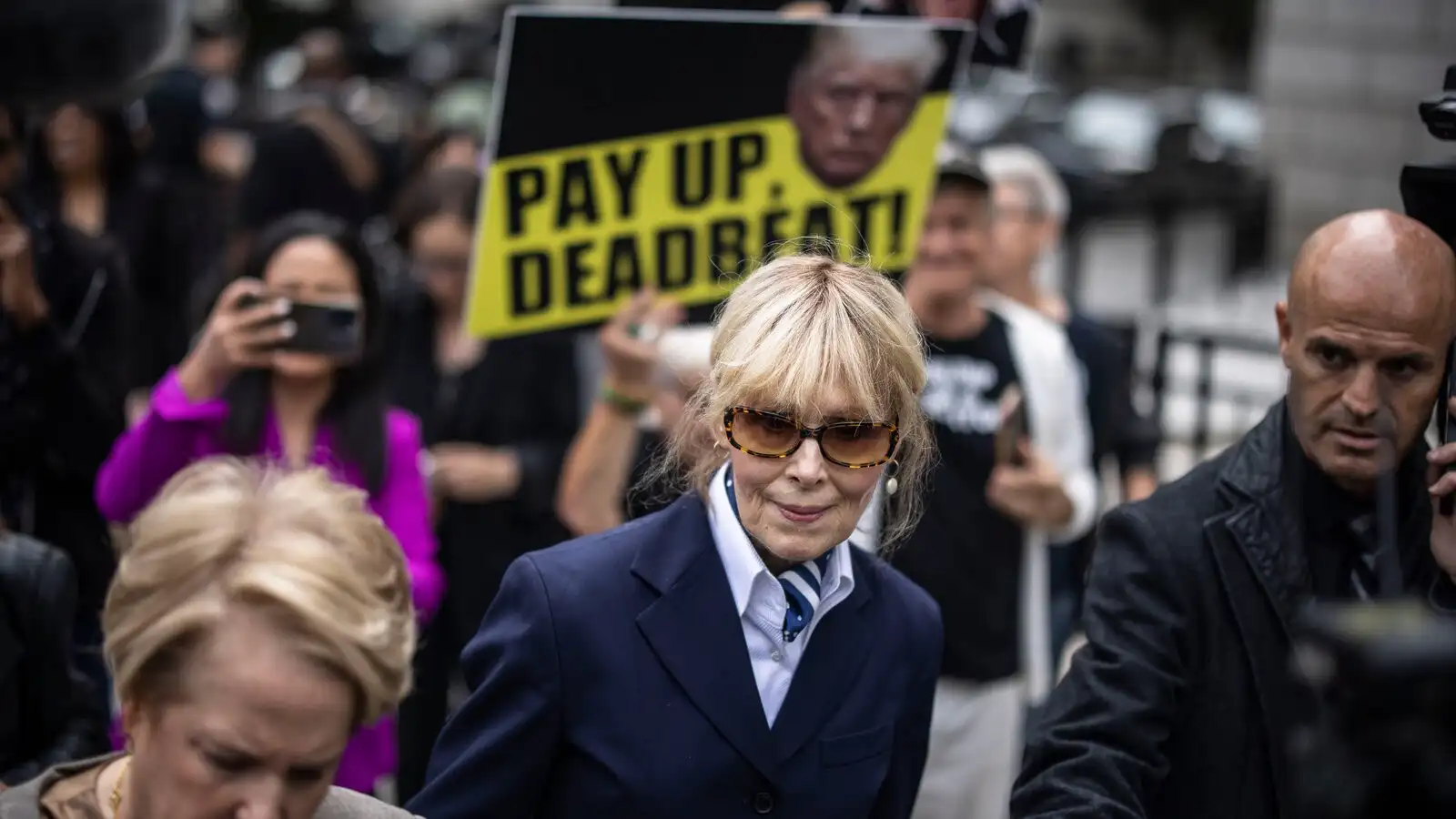
Carroll, now 80, first publicly accused Trump of sexually assaulting her in the dressing room of the upscale Bergdorf Goodman store on Manhattan's Fifth Avenue in a 2019 memoir. Trump denied ever meeting her, called the story false, and said she was 'not my type.' Carroll sued him for defamation that November.
A May 2023 jury found Trump had sexually abused Carroll and defamed her, awarding $5 million. A second jury, in January 2024, added $83.3 million after finding that Trump's ongoing public attacks amounted to defamation. Trump briefly testified at the second trial but did not appear at the first.
Wednesday's ruling marks the fourth time the Second Circuit has rejected a request for all its judges to hear an appeal in the Carroll litigation, according to Judge Chin.
On the central legal question, Chin wrote that Trump forfeited his presidential immunity argument by waiting too long to raise it — roughly 15 months after the jury returned its verdict. Under established procedure, a party cannot sit on a legal defense and then deploy it on appeal after things go badly at trial.
Trump's legal team had argued that his public statements about Carroll were made in his capacity as president following the 2016 election and should therefore be shielded by the federal Westfall Act, which allows the U.S. government to be substituted as defendant when a federal employee acts within the scope of their duties. The majority rejected that argument, finding Trump had waived it.
Three judges disagreed. Chief Judge Debra Ann Livingston, along with circuit judges Steven J. Menashi and Michael H. Park, voted to rehear the case. In a dissent authored by Menashi, the minority argued that the majority panel had wrongly denied Trump the chance to assert immunity and that the size of the $83.3 million award was 'grossly excessive.' They called the overall proceedings 'a manifest miscarriage of justice.'
Carroll's attorney, Roberta Kaplan, said her client was 'eager for this case, originally filed in 2019, to be over so that she can finally obtain justice.' Carroll has waited seven years since first filing suit, and the legal fight has outlasted Trump's first term, a presidential election, and multiple rounds of appeals.
Trump previously posted a $91.6 million bond to pause collection of the judgment while he pursued appeals. That bond remains active. His legal team did not immediately comment on the ruling.
With Wednesday's denial, Trump's most direct path forward is a petition to the U.S. Supreme Court asking it to take up the Carroll I case. The high court has not yet indicated whether it will accept a separate Carroll II petition involving the original $5 million verdict — a case that centers on slightly different legal questions but raises the same underlying immunity issues.
The Supreme Court itself handed down a landmark presidential immunity ruling in July 2024, holding that former presidents enjoy broad immunity from prosecution for official acts. How far that protection extends into civil defamation suits is an open question the high court has not directly addressed. Trump's lawyers are expected to argue that the Carroll cases present the ideal vehicle to settle that question.
Legal analysts say the Supreme Court's current composition makes it a more hospitable forum for Trump than the Second Circuit, which sits in New York and tends toward a more liberal judicial philosophy. Whether the justices choose to take the case is another matter. The court receives thousands of petitions each year and accepts only a small fraction.
For Carroll, the immediate legal win is significant even if the fight is not finished. Seven years after she first publicly named Trump, a unanimous jury verdict and multiple rounds of appellate review have all come down in her favor. The Second Circuit's majority has now validated that outcome four separate times.
The case drew renewed national attention this week as it intersects with a broader wave of Trump-era legal battles, including the separate Justice Department audit of the Epstein files release and ongoing questions about the reach of executive privilege. Critics of the dissenting judges noted that Menashi and Park are both Trump appointees, a fact the majority did not address in its ruling.
"Trump showed no remorse, continuing his attacks against Carroll during and after two federal trials, and even proclaiming two days into the first trial that he would continue to defame her 'a thousand times.'
— Judge Denny Chin, U.S. Court of Appeals for the Second Circuit, April 29, 2026
Key Rulings at a Glance
Carroll I ($83.3M defamation): Second Circuit denies en banc rehearing, 12–3, April 29, 2026. Trump's immunity defense rejected as waived.
Carroll II ($5M sexual abuse and defamation): Separate petition already before the U.S. Supreme Court. High court has not yet said whether it will accept the case.
Bond: Trump posted $91.6 million to pause collection of the larger verdict. Bond remains in force during further appellate proceedings.
Background and Legal Timeline
E. Jean Carroll first publicly accused Trump of sexual assault in a memoir published in June 2019. Trump denied the allegation and made a series of statements that Carroll argued amounted to defamation. She sued him in November 2019. After years of procedural delays, including a protracted fight over whether Trump could substitute the United States government as defendant, the case finally went to trial in May 2023.
That first jury found Trump liable for sexual abuse — a finding slightly narrower than rape under New York law — and for defamation, awarding $5 million. A second trial in January 2024 focused solely on damages for Trump's continued public attacks on Carroll after the first verdict. That jury returned the $83.3 million award, one of the largest defamation judgments against an individual in U.S. history.
Case Timeline
✓ June 2019: Carroll publicly accuses Trump of sexual assault in memoir
✓ November 2019: Carroll files defamation suit (Carroll I, 20-cv-07311)
✓ May 2023: Jury finds Trump liable for sexual abuse and defamation; awards $5 million
✓ January 2024: Second jury awards $83.3 million in defamation damages
✓ September 2025: Three-judge Second Circuit panel upholds $83.3M verdict
✓ November 2025: Trump appeals Carroll II to U.S. Supreme Court
✓ April 29, 2026: Full Second Circuit rejects en banc rehearing, 12–3
Trump is expected to petition the Supreme Court to review the larger Carroll I verdict. The high court's decision to accept or decline that petition could come within the next several months.
What Comes Next
With the Second Circuit now firmly closed as an avenue for relief, Trump's legal team faces a decision: petition the Supreme Court on both Carroll cases simultaneously or focus energy on the $5 million case already before the justices and wait to see how that plays out before filing a second petition on the $83.3 million judgment.
Whatever path they choose, the legal exposure is real. The $91.6 million bond Trump posted — covering the larger verdict plus accrued interest — remains tied up while the appeals run. Depending on the pace of Supreme Court review, that money could remain frozen for another year or more.
For Carroll and the lawyers who built this case over seven years, Wednesday's ruling is the strongest validation yet that the jury got it right. Whether the Supreme Court ultimately agrees is the one question still left unanswered.